So, you’re dreaming of earning your wings? Good news: the path to becoming a pilot is far more accessible than most people think. It’s a structured journey, sure, but it all kicks off with that one unforgettable moment in the cockpit.
This is where the dream of flying crashes headfirst into the brilliant reality of actually handling an aircraft thousands of feet in the air.
Your First Step Into the Cockpit
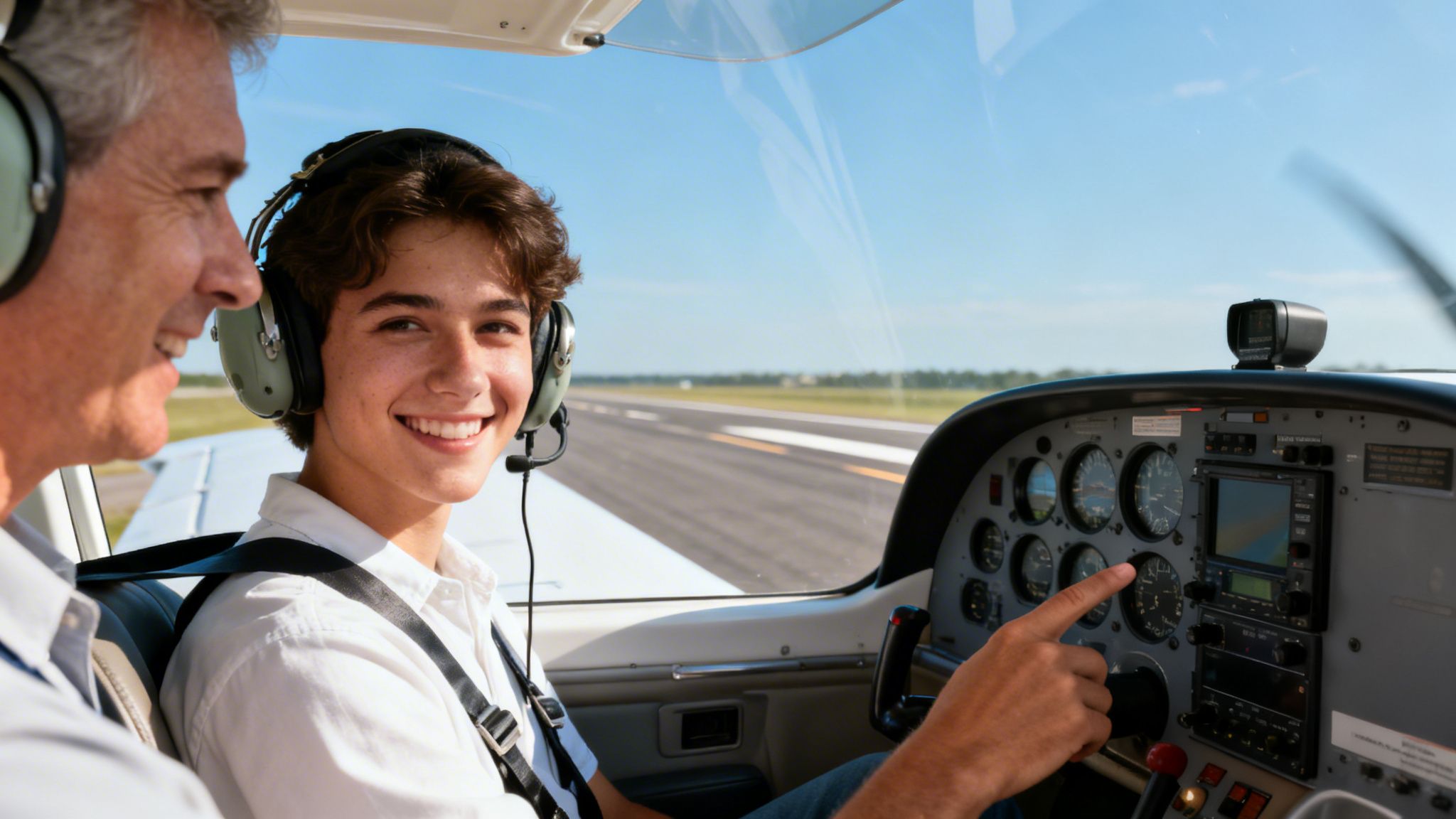
For anyone even remotely curious about getting a flying licence, there’s no better place to start than an introductory flight lesson. Forget just being a passenger on a scenic flight; this is the real deal. You’ll be in the captain’s seat, hands on the controls, with an instructor guiding you every step of the way.
It’s the perfect, low-commitment way to answer the single most important question you’ll face: "Is this really for me?"
Why a Taster Flight is the Ideal Beginning
Think of a taster flight as the ultimate "try before you buy." It completely demystifies the training process and gives you an authentic taste of what’s to come. You’ll get a genuine feel for managing the aircraft's pitch, roll, and yaw, all while learning the basics of communicating with your instructor.
A trial lesson is invaluable. It’s not just about the thrill; it's about seeing how you feel in that environment before you invest serious time and money into a full training course.
More often than not, that first flight is all it takes to light the fire. One single experience can ignite a lifelong passion and set you firmly on the path to earning your wings.
From this exciting starting point, the journey unfolds through a series of clear, manageable stages. Understanding the main types of licences available is the next logical step. The UK offers several routes, each with its own requirements and privileges:
Private Pilot Licence (PPL): The most common and versatile licence for recreational flying.
Light Aircraft Pilot Licence (LAPL): A slightly less demanding option with fewer privileges, perfect for hobbyists.
National Private Pilot Licence (NPPL): Primarily for flying microlights and other simple, lightweight aircraft.
Choosing the Right Pilot Licence for You
So, you’ve had a taste of the sky and the bug has well and truly bitten. Fantastic. Now comes the first big decision on your journey: which licence is the right one for you? This isn't just a bit of paperwork; it's the blueprint for your entire flying career, whether that's weekend jaunts or something more serious down the line.
Think about what you really want to do. Is it flying friends across the Channel for a spot of lunch? Or are you perfectly happy pottering around the local countryside, admiring the view from a few thousand feet up? Each licence comes with its own rules, training demands, and, crucially, costs. Getting this choice right from the start will save you a heap of time, money, and hassle.
Let's break down the main contenders in the UK.
The Private Pilot Licence (PPL)
The Private Pilot Licence (PPL) is the big one. It's often seen as the gold standard for private flying in the UK because it gives you the most freedom. With a PPL in your pocket, you can fly single-engine piston aircraft, take passengers along for the ride, and, with a bit more training, even fly in cloudier weather.
It’s the foundation for anyone who might one day dream of a commercial career, but it’s just as valuable for the dedicated hobbyist. It’s no surprise it’s so popular. CAA figures from 2021 showed 13,197 pilots holding a UK PPL for aeroplanes, a testament to just how many people see this as their ticket to the skies.
The trade-off for all that freedom? The requirements are a bit stricter. You'll need to pass a Class 2 Medical Certificate with an approved Aeromedical Examiner (AME). It’s a thorough check-up to make sure you're fit and healthy enough to handle the responsibility.
The Light Aircraft Pilot Licence (LAPL)
If your ambitions are a little more local, the Light Aircraft Pilot Licence (LAPL) is an absolutely brilliant, and much more accessible, option. It was created with the European leisure pilot squarely in mind. A LAPL lets you fly smaller, lighter aircraft (up to 2,000kg) and carry a maximum of three passengers. Perfect for those sunny afternoon flights.
The real appeal of the LAPL is that the training is less intense. You're looking at a minimum of 30 flight hours to qualify, compared to the PPL's 45. That difference makes it a quicker and more affordable way to get your wings. The medical is less daunting too; you'll need a LAPL Medical Certificate, which can often be sorted out with your own GP.
The LAPL is a fantastic choice if you want to fly for the sheer joy of it, exploring the UK and Europe without the more demanding commitments of the full PPL.
The National Private Pilot Licence (NPPL)
For those drawn to the lightest, simplest end of aviation, there's the National Private Pilot Licence (NPPL). This is your gateway to flying microlights and other very basic single-engine aircraft, but your adventures will be limited to UK airspace only.
The NPPL is the most straightforward of the bunch. The medical is a simple self-declaration of fitness, countersigned by your GP. The minimum hours are the lowest too, typically around 25 hours for a microlight rating. It’s the quickest route to getting airborne, but just remember that its privileges are confined to the UK, and it's not a stepping-stone to more advanced ratings in the way a PPL is.
And if you’re wondering about helicopters? That's a whole different ball game. The training and licensing are completely separate, which you can read more about in our insight into becoming a helicopter pilot.
UK Private Pilot Licenses at a Glance
To help you see how they stack up, we've put the key details side-by-side. Think of this as your cheat sheet for choosing the right path based on your flying goals.
| Feature | Private Pilot Licence (PPL) | Light Aircraft Pilot Licence (LAPL) | National Private Pilot Licence (NPPL) |
|---|---|---|---|
| Minimum Flight Hours | 45 hours | 30 hours | 25 hours (Microlight) |
| Medical Requirement | Class 2 Medical Certificate | LAPL Medical Certificate | Self-Declaration (with GP signature) |
| Aircraft Privileges | Single-engine aircraft up to 5,700kg | Single-engine aircraft up to 2,000kg | Simple single-engine aircraft & microlights |
| Passenger Limit | Dependent on aircraft type | Maximum of 3 passengers | Dependent on aircraft type (often 1) |
| Where You Can Fly | Worldwide (with valid ratings) | UK and Europe | UK airspace only |
| Best For | Aspiring career pilots or those wanting maximum freedom | Hobbyist pilots flying for leisure in Europe | Microlight enthusiasts flying locally in the UK |
Ultimately, the best licence is the one that fits your dream. Be realistic about what you want to achieve, how much time you can commit, and what your budget looks like. Choosing wisely now sets you up for years of happy flying.
Ground School vs. Flight Hours: The Two Sides of Your Training
Once you’ve picked the licence you’re aiming for, your training essentially splits into two streams that run side-by-side: the theory you learn in ground school, and the practical skills you build up during your flight hours. Both are non-negotiable, and the secret to success is keeping them in balance.
Think of it this way: ground school is learning the Highway Code before you get in the car. It’s the ‘why’ behind every check, every decision, every radio call. The flight hours? That’s where you actually learn to drive, putting all that theory into practice and building the real-world skills and muscle memory to fly an aircraft safely and confidently.
Mastering the Theory on the Ground
Before you’re let loose in the skies, you need to prove you’ve got a solid grasp of the principles of aviation. This means passing nine written exams. It sounds like a lot, but they cover the essential knowledge every single pilot needs to operate safely in UK airspace.
Most flight schools have you covered, offering everything from structured classroom lessons and online courses to one-on-one tuition to get you through them.
Here are the nine subjects you’ll need to get your head around:
Air Law: The rules of the sky. This is non-negotiable for every pilot.
Aircraft General Knowledge: The nuts and bolts of your aircraft, from the engine to the instruments.
Flight Performance and Planning: Learning how to calculate fuel burn, take-off distances, and the all-important weight and balance.
Human Performance and Limitations: A fascinating look at the psychology and physiology that can affect your performance in the cockpit.
Meteorology: How to read weather charts and make sensible go/no-go decisions. This is a critical skill.
Navigation: From traditional map-and-compass work to using modern radio aids to figure out where you are and where you’re going.
Operational Procedures: This covers the standard protocols used in aviation, including vital safety drills.
Principles of Flight: The aerodynamics bit – what actually makes the aeroplane fly.
Communications: Mastering the specific language of the radio to talk clearly to Air Traffic Control and other aircraft.
Each exam is multiple-choice, and the pass mark is 75%. You can tackle them at your own pace throughout your training, but you have to get all nine passed within an 18-month window before you’re allowed to take your final skills test.
Earning Your Wings in the Air
While the theory is vital, let’s be honest—the real magic happens in the air. This is where you’ll log your flight hours and build your practical skills under the watchful eye of your instructor.
For a PPL, the Civil Aviation Authority (CAA) sets the bar at a minimum of 45 hours of flight training. This is split into two very distinct types of flying.
The flight training phase is where it all clicks. Abstract ideas like stall recovery and crosswind landings suddenly become very real, tangible skills. Each lesson builds on the last, and you can feel your confidence and competence growing every time you step into the cockpit.
This flowchart gives a great side-by-side look at the requirements for the most popular UK licences.
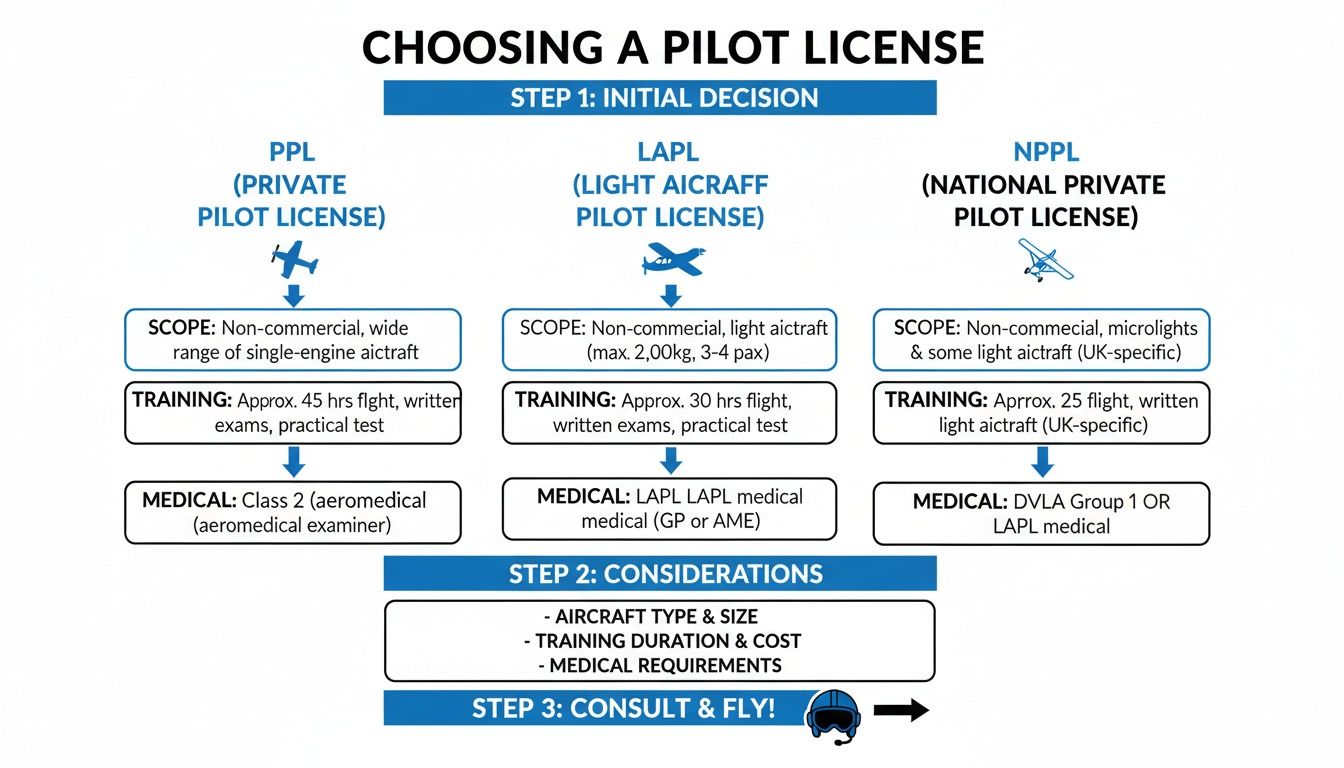
You can see how the PPL asks for a bigger time commitment but gives you much broader privileges than the LAPL or NPPL in return.
Dual and Solo Flight Time
Your training hours are broken down like this:
Dual Instruction: At least 25 hours of your training must be 'dual', meaning you’re flying with an instructor sitting next to you. They'll teach you everything from basic climbs and turns to complex emergency drills and navigating cross-country.
Solo Flight Time: You’ll also need a minimum of 10 hours flying as Pilot in Command (PIC). That’s you, and only you, in the aircraft. This includes a big milestone: a qualifying cross-country flight of at least 150 nautical miles, with landings at two different airfields along the way.
Your first solo flight is a moment no pilot ever forgets. It's that quiet, exhilarating flight around the circuit where you realise, "I'm actually doing this." Your instructor will only send you when they are 100% confident you can handle the aircraft and its procedures safely.
It’s crucial to remember that 45 hours is a minimum. Very few people are ready for their test at exactly 45 hours on the dot. In reality, the average is closer to 55-60 hours. It’s not a race; it’s about being a safe, competent pilot.
If you’re keen to practise procedures without burning fuel, a 90-minute flight simulator experience is a fantastic way to get a feel for complex scenarios in a safe environment. It’s a great supplement to your time in a real aircraft.
Passing Your Medical and Skills Test
After months of dedicated study and countless hours in the air, the final milestones are in sight. Before you can earn those coveted wings, you’ve got to prove two things: you’re medically fit to fly, and you’re a competent, safe pilot.
These last steps—the medical exam and the final skills test—can feel pretty daunting, but they're really just a confirmation of everything you've already learned. Think of them not as hurdles, but as the final items on your pre-flight checklist, designed to make sure you and your future passengers will always be safe in the sky.

Securing Your Class 2 Medical Certificate
For a PPL, you must hold a valid Class 2 Medical Certificate. Now, this isn't nearly as intimidating as it sounds. The examination is done by a specially trained Aeromedical Examiner (AME) and is essentially a thorough health check-up. Its main purpose is to ensure there are no underlying conditions that could pose a risk up in the air.
The aviation medical will look at your overall health, sometimes including a comprehensive blood test to check various markers. You can expect the AME to have a good look through your medical history and run a few standard checks.
Here’s what’s usually involved:
Vision and Colour Perception: Your eyesight gets tested, but you don’t need perfect 20/20 vision. It just needs to be correctable to a specific standard with glasses or contact lenses.
Hearing Test (Audiogram): This just makes sure you can clearly hear radio calls and important aircraft sounds.
Lung Function Test (Spirometry): A simple puff into a machine to check your respiratory health.
Electrocardiogram (ECG): This measures your heart's rhythm and electrical activity. It's usually required for your first medical and then at regular intervals depending on your age.
General Physical Examination: The AME will check your blood pressure, reflexes, and overall physical condition.
For most people, the medical is a straightforward process. The key is simply to be open and honest about your medical history. Plenty of common conditions, like well-managed asthma or diabetes, are not necessarily disqualifying.
Conquering the Final Skills Test
The Skills Test, often called the 'checkride', is the practical exam that stands between you and your licence. It’s your chance to show a CAA-approved examiner that you can put all your training into practice and fly to the required standard. The test usually lasts 2 to 2.5 hours and is split into two main parts: navigation and general handling.
Your instructor will only put you forward for the test when they are 100% confident you’re ready. You’ll have practised every single manoeuvre and procedure to perfection long before you ever meet the examiner.
The skills test isn't about trick questions or impossible challenges. The examiner wants you to pass. They are there to observe a safe, well-planned, and competently flown flight from start to finish.
What the Examiner is Looking For
The test will cover a wide range of skills you've honed throughout your training.
Navigation Section:
This is usually the first part of the test. You'll plan a cross-country route on the ground and then fly it, proving you can navigate using your map, compass, and stopwatch. The examiner will also test your ability to divert to an alternate destination—a crucial skill if bad weather suddenly rolls in.
General Handling and Emergency Drills:
After the navigation leg, the focus shifts to your general aircraft handling skills. This includes:
Stalls and Recovery: Safely recognising and recovering from an aerodynamic stall.
Steep Turns: Performing controlled turns at a steep bank angle while maintaining altitude.
Emergency Procedures: Responding correctly to simulated emergencies, like an engine failure just after take-off or a forced landing without power.
Circuits: Flying accurate take-offs, circuits, and landings, including showing you can handle a crosswind.
Passing both the medical and the skills test is the culmination of all your hard work. It's the moment you finally transition from student pilot to a qualified aviator, ready to explore the world from a whole new perspective.
Budgeting for Your Pilot Licence
Let's talk numbers. Getting your hands on a flying licence is one of life's great adventures, but it's crucial to go into it with your eyes wide open about the financial and time commitment. While everyone's journey is a little different, a realistic budget for a Private Pilot Licence (PPL) in the UK usually lands somewhere between £8,000 and £12,000.
That might seem like a broad range, but the final bill is shaped by a few key things: the flight school you choose, where it’s based, the type of aircraft you learn in, and how often you get up in the air. Nailing down these variables from the start helps you manage your expectations and dodge any nasty financial surprises down the line.
Breaking Down the Core Costs
The good news is you don't pay for it all in one go. Think of it more like a 'pay-as-you-fly' journey, where each part of your training is a separate investment towards the final goal.
Here are the main expenses you'll need to account for:
Aircraft & Instructor Fees: This is the big one and the bulk of your budget. It's typically charged by the hour, and you can expect to pay anywhere from £150 to over £250 per hour, depending on the aircraft and the instructor's experience.
Ground School & Exams: You've got nine written theory exams to pass. The exam fees themselves are fairly modest at around £35-£40 a pop, but you'll also need to budget for study materials or formal ground school tuition.
The Medical: Your initial Class 2 Medical Certificate with an Aeromedical Examiner (AME) will set you back a few hundred pounds. It's a non-negotiable first step.
Your Kit: You'll need to invest in some personal gear. A decent headset is a must-have, costing anything from £150 to over £800. You'll also need navigation tools like charts, a flight computer (the old-school 'whizz wheel'!), and a protractor.
The Final Hurdles: At the very end, there are fees for your practical skills test with an examiner and, of course, for the CAA to issue your shiny new licence.
Planning your finances is just as critical as planning a cross-country flight. A clear, honest budget keeps your training on track and stops money worries from getting in the way of your learning.
What Pushes the Final Cost Up or Down?
So, why the big difference in the total cost? The single biggest factor is consistency. Flying regularly, say once or twice a week, is the secret sauce. It keeps the knowledge fresh, helps you progress faster, and often means you'll need fewer hours overall to get to test standard.
On the flip side, long gaps between lessons are a budget killer. You'll spend the first chunk of every session just getting back to where you were last time, which stretches out your training and racks up the cost. Location plays a part, too. A school at a bustling commercial airport will naturally have higher hourly rates than one tucked away at a quiet countryside airfield.
Many people find themselves in a better position to learn to fly later in life. For microlight pilots, for instance, the average age of a newly qualified NPPL pilot is 44. They often start with the financial stability to see it through without long interruptions.
How Long Does It All Take?
Just like the cost, the timeline varies. If you went full-time on an intensive course, you could be qualified in a few months, but that’s not a realistic option for most of us.
The vast majority of student pilots are juggling their training around jobs, families, and life in general. Because of this, a much more typical timeframe to complete a PPL is somewhere between one and two years. This part-time approach lets you spread the cost and learn at a pace that doesn't feel overwhelming. To help with the financial side, it can be worth exploring student finance options for mature students.
Ultimately, remember that consistency beats speed every time. Steady, regular progress is what will turn you into a safe, confident, and competent pilot.
Common Questions About Getting a Flying Licence
Even with a clear plan, the journey to getting your wings is a big one, and it's totally normal to have a few questions rattling around. Think of this as your final pre-flight check – a quick, no-nonsense rundown of the stuff aspiring pilots often ask, clearing up any last-minute wobbles before you head to the airfield.
We’ve heard all the myths and practical worries over the years. So, let’s tackle them head-on and get you feeling confident about the adventure ahead.
What Is the Minimum Age to Start Flying?
This is a classic, and the answer is probably younger than you think. You can officially start logging flight training hours from the age of 14.
This gives keen teenagers a fantastic head start, letting them get to grips with the practical side of flying. Then comes one of the biggest milestones in any pilot's life: flying solo. You can do that once you turn 16. However, to have the actual Private Pilot Licence (PPL) or Light Aircraft Pilot Licence (LAPL) issued, you'll need to be at least 17 years old.
And what about an upper age limit? There isn't one. As long as you can pass the medical checks and prove you’re safe and competent in the cockpit, you can keep flying well into your later years.
Do I Need Perfect 20/20 Vision?
Let’s put this myth to bed once and for all. You absolutely do not need perfect, unaided vision to become a private pilot. It’s probably the most persistent rumour in aviation, and it’s simply not true.
It’s a huge misconception that wearing glasses or contact lenses will ground your flying dreams. The reality is, the CAA is concerned with your corrected vision, not your unaided sight.
For the Class 2 Medical Certificate you need for a PPL, your eyesight just has to be correctable to the required standard. The Aeromedical Examiner (AME) will check this during your medical. If your specs or contacts get your vision up to snuff, you're good to go. Thousands of perfectly safe and capable pilots fly with corrective lenses every single day.
How Do I Find the Right Flight School?
Choosing where you learn to fly is one of the most important decisions you’ll make. A good school doesn't just teach you the syllabus; it shapes your habits, your confidence, and your entire attitude as a pilot. Kick things off by looking for a CAA-approved training organisation (ATO) or a registered training facility (RTF).
But don't just pick one from a slick website. The best way to get a real feel for a place is to visit a few local airfields. See the hangars, check out the training aircraft, and soak up the atmosphere.
Chat with the instructors: Are they passionate? Do they seem genuinely invested in their students? A great instructor is a mentor, not just someone ticking boxes.
Talk to current students: Get the real story. Ask them what they love (and what they don't) about the school.
Look at the fleet: Are the planes well-maintained? Is there enough availability, or will you be fighting for slots every weekend?
An introductory trial lesson is the perfect way to ‘interview’ a flight school. It’s a test flight for them as much as it is for you, giving you a proper insight into whether it’s the right fit.
What Can I Do After Getting My PPL?
Earning your PPL isn't the finish line; it’s the start of a lifetime of adventure. Once that licence is in your hand, a whole new world opens up. You’re now qualified to act as Pilot in Command (PIC) of a single-engine aircraft.
So, what does that actually mean? You can:
Fly with passengers: Finally, you can share the magic with friends and family. A trip to another airfield for a bacon butty is a classic PPL day out.
Explore the UK and beyond: Your PPL is an internationally recognised licence, so you can hop across the Channel or explore far-flung corners of the globe in good weather.
Keep learning: The PPL is a fantastic foundation. Many pilots go on to add extra 'ratings' to their licence, like a Night Rating to fly after sunset or an Instrument Rating for flying in the clouds.
And for anyone dreaming of a career in the airlines, the PPL is the first major rung on the ladder. It’s the core qualification that all professional licences are built upon.
Ready to turn that dream of flying into a reality? We make it easy to take that incredible first step. Our flying lesson experiences are the perfect introduction to the cockpit, giving you hands-on control under the guidance of a professional instructor. Start your aviation journey today.